What Is a PAPR Welding Helmet?
A PAPR welding helmet is a welding helmet sealed to a powered air-purifying respirator: a belt blower pulls air through a HEPA-class filter and pushes it into the helmet, so you breathe filtered air without effort. It's worth it for daily welding on galvanized, stainless or in confined spaces.
Our best PAPR welding helmet pick is the Optrel crystal 2.0 with e3000X PAPR.
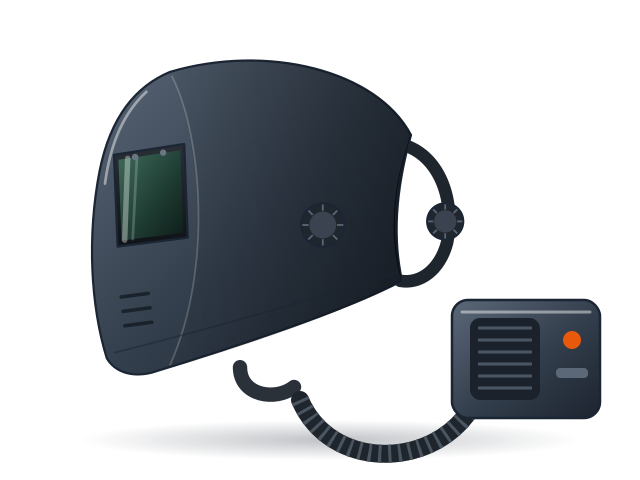
What's the best air fed welding mask
Among systems we could buy on Amazon, the Optrel crystal 2.0 with e3000X: Optrel's US page says it's NIOSH-certified, with a TH3 HEPA filter and up to 18 h of battery. “Air fed” sometimes means supplied-air (a hose from a compressor) — a different system for heavier industrial use.
How a PAPR works
The blower draws air through a particulate filter and sends it up a hose into the helmet, creating positive pressure so fume can't leak in. Because it's loose-fitting, it works with beards and needs no fit test; Lincoln's manual cites an assigned protection factor of 25.
PAPR vs a half mask under a helmet
A half mask like the Miller LPR-100 Half Mask, S/M costs a small fraction of a PAPR and is fine for occasional work, but it needs a fit test, a clean shave and some breathing effort. See welding respirators.
What's in a PAPR system
- Helmet with a face seal that keeps the filtered air inside and fume outside.
- Breathing hose from the blower to the back of the helmet.
- Blower unit on a belt, with a rechargeable battery and an airflow alarm.
- Filters: a particle filter, usually with a spark arrestor and a pre-filter in front of it.
Looking after a PAPR
Swap the spark arrestor and pre-filter often, because they protect the main filter. Replace the main filter when the airflow alarm sounds or on the schedule in the maker's manual, charge the battery after each shift, and check the hose for cracks. Use only the maker's filters, because the NIOSH approval covers the system as tested.
Who needs a PAPR
Daily welding on galvanized or stainless steel, work in confined spaces, and welders with beards, who can't get a tight seal on a half mask. At work, your employer's respiratory protection program decides what's required; for galvanized work, start with our galvanized steel respirator guide.
Our recommendation
If you weld fume-heavy metals daily, a PAPR is worth it — see our PAPR picks.