We rank by manufacturer weight for the complete helmet. Makers that publish only a shell weight are listed separately, because a shell without headgear and lens isn't comparable. Heavier helmets can still feel lighter with good headgear — see replacement headgear.
We may earn a commission when you buy through our links. As an Amazon Associate I earn from qualifying purchases. How this works.
Lightweight welding helmets, ranked by verified weight
Ranked by our published method: manufacturer-verified safety specs first, then optical class, viewing area, sensors and switching speed, comfort and weight, buyer feedback and value.
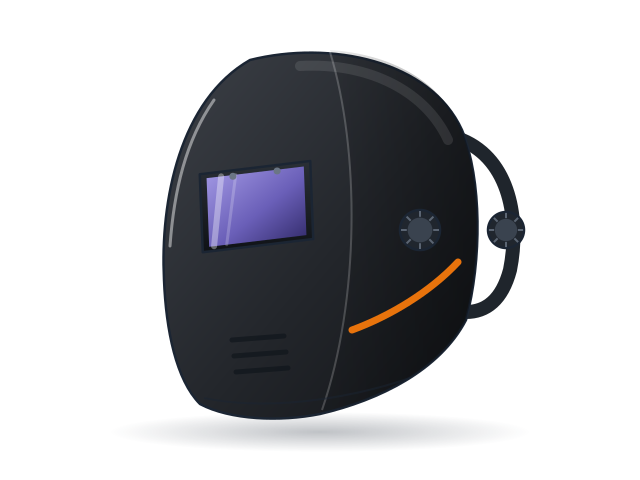
Miller · model Classic Series VS 287803 · $60–$150
454 g per Miller — the lightest complete auto-darkening helmet with a manufacturer weight.
Shade3.0 / 8–13 (cut 5–8, grind 3)
Viewing area6 sq in
Arc sensors2
Switching1/23,000 s
Optical class1/1/1/2
Weight454 g
CertificationsANSI Z87.1+, CSA, CE
Best forTIG · MIG · beginners
Pros
454 g — the lightest verified complete auto-darkening helmet we list
Weld 8–13, cut 5–8 and grind 3 with digital controls
5 A TIG rating; ANSI Z87.1+, CSA and CE (Miller)
3-year lens warranty
Cons
Two sensors and 1/23,000 s switching
6 sq in window — the smallest of the premium-brand helmets
Some buyers report the headgear breaking within weeks; 1/1/1/2
Skip it if: Out-of-position welders — two sensors are easier to block than four.
Spec score 68/100 (verified specs only, not a test score): Optical class 20/25 · Viewing area 11/25 · Arc sensors 7/15 · Switching speed 8/10 · Weight 10/10 · Warranty 4/5 · Value 8/10. How it works
50 × 100 mm window (about 7.75 sq in) is small for the price
Dark range stops at 12; Optrel's pages name EN 379 but not ANSI Z87.1
Skip it if: Heavy stick or gouging work that needs darker than shade 12, or anyone who wants a big window.
Spec score 68/100 (verified specs only, not a test score): Optical class 20/25 · Viewing area 15/25 · Arc sensors 11/15 · Switching speed 5/10 · Weight 10/10 · Warranty 3/5 · Value 4/10. How it works
4 × 4 in (16 sq in) viewing area — far bigger than cheap passives
ANSI Z87.1+ and CSA Z94.3 in Miller's manual
Takes a standard 4.5 × 5.25 in plate, so you can drop in an auto-darkening lens later
Cons
Fixed shade 10 — you nod it down for every strike
Miller lists 16 oz on one page and 18 oz in the manual
No spare cover lenses in the box; some buyers find the shell flimsy
Skip it if: TIG welders or anyone who tacks a lot.
Spec score 44/100 (verified specs only, not a test score): Optical class 0/25 · Viewing area 25/25 · Arc sensors 0/15 · Switching speed 0/10 · Weight 8/10 · Warranty 3/5 · Value 8/10. How it works
Buyers like the smooth tilt and headgear adjustment
Cons
Lincoln states the plate size, not the visible window
CSA Z94.3 appears only on retailer listings
Fixed shade 10
Skip it if: Anyone who wants a light state between welds.
Spec score 19/100 (verified specs only, not a test score): Optical class 0/25 · Viewing area 0/25 · Arc sensors 0/15 · Switching speed 0/10 · Weight 8/10 · Warranty 3/5 · Value 8/10. How it works
Four arc sensors and a 100 × 60 mm (9.3 sq in) window, per Hobart's spec sheet
Meets ANSI Z87.1-2015, CSA and EN 379 (Hobart)
560 g with simple analog shade, sensitivity and delay knobs
Buyers say it rivals far pricier helmets for visibility
Cons
Hobart does not publish an optical class
Dark range 9–13 only — no 5–8 range for torch or plasma cutting
Some buyers say the shell feels fragile; 2-year warranty
Skip it if: Low-amp TIG welders or anyone plasma cutting, who need the 5–8 shades it lacks.
Spec score 61/100 (verified specs only, not a test score): Optical class 0/25 · Viewing area 17/25 · Arc sensors 15/15 · Switching speed 10/10 · Weight 8/10 · Warranty 3/5 · Value 8/10. How it works
Jackson states 6 oz for the shell — not comparable to full-helmet weights, so listed separately.
Shadefixed 10 IR (passive polycarbonate filter)
Viewing areaNot published
Arc sensorsPassive
SwitchingPassive
Optical classNot published
Weight170 g (shell)
CertificationsANSI Z87.1-2010, CSA Z94.3
Best forstick · MIG
Pros
Jackson states 6 oz for the Hydraflex shell
ANSI Z87.1-2010 and CSA Z94.3
Hard-hat adaptable with Jackson's 187-S adapter; takes Jackson ADFs
Cons
The 6 oz figure is the shell, so it is not comparable to complete-helmet weights
1-year warranty
Polycarbonate shade 10 filter
Skip it if: Anyone wanting more than a 1-year warranty.
Spec score 9/100 (verified specs only, not a test score): Optical class 0/25 · Viewing area 0/25 · Arc sensors 0/15 · Switching speed 0/10 · Weight 0/10 · Warranty 1/5 · Value 8/10. How it works
Skip it if: Anyone on a budget — the fiberglass Pipeliner costs about half.
Not scored: a hood's protection comes from the lens you fit, so we don't give hoods a spec score. Fit a lens with an ANSI Z87.1 mark and the right shade for your process; the lens size finder shows which lenses fit.
A low profile welding mask matters more than raw weight when you work under vehicles or between pipes. Pipeliner hoods like the Fibre-Metal Pipeliner are the most compact; among standard helmets the ESAB Sentinel A60 is described by ESAB as low-profile but is 644 g, so it's compact rather than light.
Smaller-fit, lighter welding helmets for women
There's no separate safety standard for welding helmets for women; what matters is headgear that adjusts small enough and a helmet light enough for your neck. The Miller Classic VS ClearLight (Black) is the lightest verified option, and the Lincoln Electric Viking 3350 (Black)'s listing says its headgear fits hat sizes 6½–8. If a helmet slides, a smaller replacement headband usually fixes it.