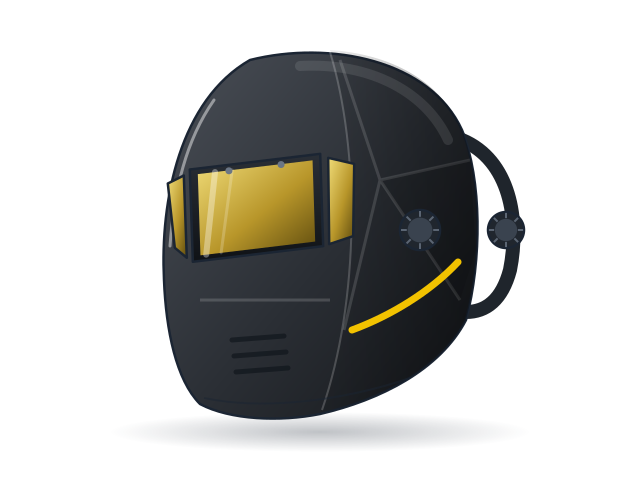
The best TIG welding helmet is the Lincoln Electric Viking 3350 (Black): Lincoln rates it for TIG down to ≥2 A AC/DC, with 4 sensors, a lighter 5–8 shade range and a 1/1/1/1 lens.
TIG is the hardest test for an auto-darkening lens: the arc is small and steady, and your torch or filler hand can shade a sensor. We rank on verified low-amp ratings, four sensors and a low shade option. OSHA's minimum for TIG under 150 A is shade 8 (see the welding shade chart).
We may earn a commission when you buy through our links. As an Amazon Associate I earn from qualifying purchases. How this works.
Ranked by our published method: manufacturer-verified safety specs first, then optical class, viewing area, sensors and switching speed, comfort and weight, buyer feedback and value.
The lowest verified TIG rating (2 A AC/DC), four sensors, a 5–8 range and 1/1/1/1.
Shade3.5 / 5–13
Viewing area95 × 85 mm (12.5 sq in)
Arc sensors4
Switching1/25,000 s
Optical class1/1/1/1
Weight595 g
CertificationsANSI Z87.1-2010, CSA Z94.3, EN 379
Best forTIG · MIG · stick · pros
Pros
1/1/1/1 optical class and a 95 × 85 mm (about 12.5 sq in) window, both from Lincoln's spec sheet
Four arc sensors and a TIG rating of 2 A AC/DC, the lowest verified rating of any helmet we list
Two dark ranges (5–8 and 9–13) plus a 3.5 light state cover cutting, low-amp TIG and heavy stick
Buyers consistently single out the clarity and say the extra cost is justified for daily use
Cons
Costs roughly four times a Hobart Inventor, which also has four sensors
595 g: about 140 g heavier than the Miller Classic VS
Some buyers report it crowds certain 3M half-mask respirators
Lincoln's product page says 3-year warranty, its spec sheet says 5 — confirm at purchase
Skip it if: Occasional hobby welders — a Hobart Inventor or Miller Classic VS covers weekend MIG for a fraction of the price.
Spec score 85/100 (verified specs only, not a test score): Optical class 25/25 · Viewing area 23/25 · Arc sensors 15/15 · Switching speed 10/10 · Weight 8/10 · Warranty 0/5 · Value 4/10. How it works
Also 2 A AC/DC, four sensors and 1/1/1/1, with a smaller window.
Shade5–13 (grind 3.5)
Viewing area97 × 62 mm (9.3 sq in)
Arc sensors4
Switching1/25,000 s
Optical class1/1/1/1
Weight639.5 g
CertificationsANSI Z87.1, CSA Z94.3
Best forTIG · MIG · stick
Pros
1/1/1/1 4C lens, four sensors, TIG rating of 2 A AC/DC
Push-button digital controls for shade, sensitivity and delay
Removable LED module with its own AA battery
5-year warranty on Lincoln's spec sheet
Cons
97 × 62 mm window is noticeably smaller than the 3350's 95 × 85 mm
639.5 g, or 680 g with the LED module
Delay only adjusts from 0.1 to 0.25 s
Skip it if: Stick welders running long rods at high amps who want a long dark-to-light delay.
Spec score 82/100 (verified specs only, not a test score): Optical class 25/25 · Viewing area 17/25 · Arc sensors 15/15 · Switching speed 10/10 · Weight 6/10 · Warranty 5/5 · Value 4/10. How it works
5 A TIG, four sensors, cut 5–8 and X-Mode for sensors blocked by the torch.
Shade2.5 / 8–13 (cut 5–8)
Viewing area9.2 sq in
Arc sensors4
Switching1/25,000 s
Optical class1/1/1/2
Weight607 g
CertificationsANSI Z87.1+, CSA
Best forTIG · MIG · stick · pros
Pros
X-Mode detects the arc electromagnetically, so it keeps working outdoors or with blocked sensors
Weld (8–13), cut (5–8), grind and X-Mode in one helmet, with half-shade steps
5 A TIG rating and four sensors, per Miller's spec sheet
4-year auto-darkening lens warranty
Cons
1/1/1/2 per Miller's own sheet
9.2 sq in window — smaller than the Viking 3350 at a similar price
607 g, about 150 g more than Miller's own Classic VS
Skip it if: Shop-only MIG welders — the X-Mode premium buys little indoors.
Spec score 77/100 (verified specs only, not a test score): Optical class 20/25 · Viewing area 17/25 · Arc sensors 15/15 · Switching speed 10/10 · Weight 6/10 · Warranty 5/5 · Value 4/10. How it works
Miller · model Digital Infinity 296786 · $300–$600
5 A TIG with the largest view.
Shade2.5 / 8–13 (cut 5–8)
Viewing area13.4 sq in
Arc sensors4
Switching1/25,000 s
Optical class1/1/1/2
Weight606 g
CertificationsANSI Z87.1+, CSA
Best forMIG · TIG · pros
Pros
13.4 sq in viewing area, the largest manufacturer-stated window on this site
X-Mode, AutoSense and InfoTrack 2.0 like the Digital Elite
606 g — no heavier than the Elite despite the bigger window
5 A TIG rating, four sensors, 4-year lens warranty
Cons
1/1/1/2 per Miller
Miller publishes the area but not the window dimensions
A buyer complaint about the headgear quality stands out at this price
Skip it if: Budget buyers — a YesWelder LYG-M800H claims a similar window for a tenth of the price, though without verified certifications.
Spec score 85/100 (verified specs only, not a test score): Optical class 20/25 · Viewing area 25/25 · Arc sensors 15/15 · Switching speed 10/10 · Weight 6/10 · Warranty 5/5 · Value 4/10. How it works
ESAB pages disagree on switching time (0.04 ms vs 0.8 ms in a press release); we use the spec page
Skip it if: Anyone sensitive to helmet weight — the Miller Classic VS is 190 g lighter.
Spec score 84/100 (verified specs only, not a test score): Optical class 25/25 · Viewing area 24/25 · Arc sensors 15/15 · Switching speed 10/10 · Weight 6/10 · Warranty 0/5 · Value 4/10. How it works
The Miller Classic VS ClearLight (Black) is the cheapest helmet we found with a published TIG rating (5 A and below) and a 5–8 cutting range, but it has two sensors. It's fine for bench TIG; for out-of-position work, save for a four-sensor helmet.
Best welding hood for TIG
Hoods are rarely ideal for TIG because most take a 2 × 4¼ in lens with a small view. If you prefer a hood, fit a lens rated for low-amp TIG — Lincoln rates its 2x4C variable lens to 5 A — in a shell it's confirmed to fit, like the Fibre-Metal Pipeliner.