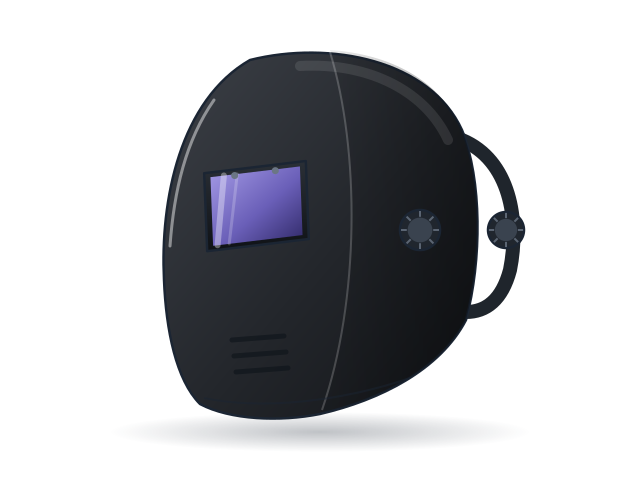
The best welding helmet for beginners is the Miller Classic VS ClearLight (Black): simple controls, a 3.0 / 8–13 (cut 5–8, grind 3) shade range that covers MIG, TIG and cutting, and only 454 g, in the $60–$150 band.
Beginners need an auto-darkening helmet with forgiving sensitivity and delay settings, documented protection and a price under $150. Everything below meets that. Start with how to adjust a welding helmet once yours arrives.
We may earn a commission when you buy through our links. As an Amazon Associate I earn from qualifying purchases. How this works.
Ranked by our published method: manufacturer-verified safety specs first, then optical class, viewing area, sensors and switching speed, comfort and weight, buyer feedback and value.
Miller · model Classic Series VS 287803 · $60–$150
Simple digital controls, a 3.0 light state, cut shades 5–8 and a 5 A TIG rating under $150.
Shade3.0 / 8–13 (cut 5–8, grind 3)
Viewing area6 sq in
Arc sensors2
Switching1/23,000 s
Optical class1/1/1/2
Weight454 g
CertificationsANSI Z87.1+, CSA, CE
Best forTIG · MIG · beginners
Pros
454 g — the lightest verified complete auto-darkening helmet we list
Weld 8–13, cut 5–8 and grind 3 with digital controls
5 A TIG rating; ANSI Z87.1+, CSA and CE (Miller)
3-year lens warranty
Cons
Two sensors and 1/23,000 s switching
6 sq in window — the smallest of the premium-brand helmets
Some buyers report the headgear breaking within weeks; 1/1/1/2
Skip it if: Out-of-position welders — two sensors are easier to block than four.
Spec score 68/100 (verified specs only, not a test score): Optical class 20/25 · Viewing area 11/25 · Arc sensors 7/15 · Switching speed 8/10 · Weight 10/10 · Warranty 4/5 · Value 8/10. How it works
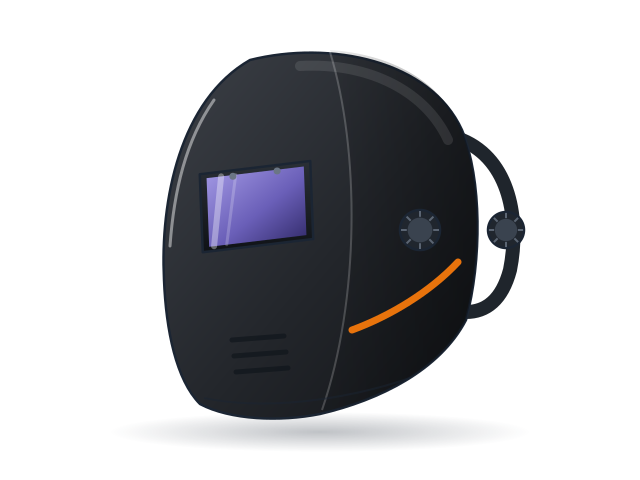
Four arc sensors and a 100 × 60 mm (9.3 sq in) window, per Hobart's spec sheet
Meets ANSI Z87.1-2015, CSA and EN 379 (Hobart)
560 g with simple analog shade, sensitivity and delay knobs
Buyers say it rivals far pricier helmets for visibility
Cons
Hobart does not publish an optical class
Dark range 9–13 only — no 5–8 range for torch or plasma cutting
Some buyers say the shell feels fragile; 2-year warranty
Skip it if: Low-amp TIG welders or anyone plasma cutting, who need the 5–8 shades it lacks.
Spec score 61/100 (verified specs only, not a test score): Optical class 0/25 · Viewing area 17/25 · Arc sensors 15/15 · Switching speed 10/10 · Weight 8/10 · Warranty 3/5 · Value 8/10. How it works
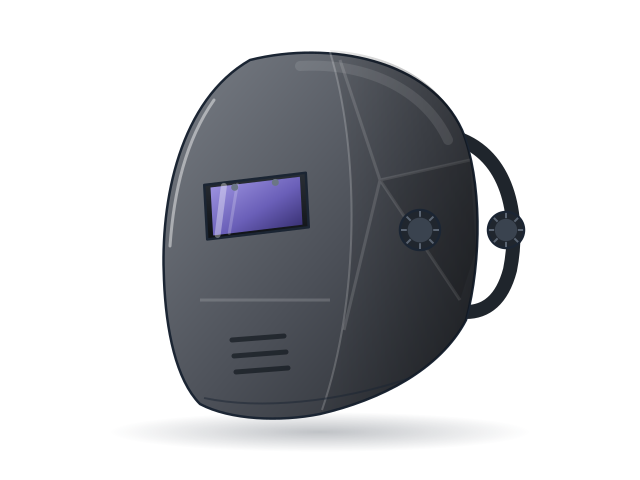
External shade knob and documented protection at the lowest price.
Shade9–13 (light state not stated; grind option per product page)
Viewing area3.62 × 1.65 in (6 sq in)
Arc sensors2
Switching1/25,000 s
Optical class1/1/1/2
Weight470 g (shell)
CertificationsANSI Z87.1, EN 166, EN 175, EN 379
Best forMIG · flux-core · beginners
Pros
ANSI Z87.1, EN 166, EN 175 and EN 379 in Forney's own manual
Published 1/1/1/2 optical class and 1/25,000 s switching
External shade knob; TIG-rated to 5 A
Cons
Two sensors and a 5.97 sq in window
Dark range 9–13 only
Forney's manual says the lithium cells are not replaceable (product page says CR2032 — check yours)
Skip it if: Anyone who welds daily or needs a cutting shade range.
Spec score 58/100 (verified specs only, not a test score): Optical class 20/25 · Viewing area 11/25 · Arc sensors 7/15 · Switching speed 10/10 · Weight 0/10 · Warranty 0/5 · Value 10/10. How it works
Start darker than you think and go lighter until you can see the puddle clearly — never below OSHA's minimum:
OSHA minimum shades for common beginner processes
Process
Current / thickness
Minimum shade
Shielded metal arc (stick)
Under 60 A (electrode under 3/32 in)
7
Shielded metal arc (stick)
60–160 A (3/32–5/32 in)
8
Shielded metal arc (stick)
160–250 A (5/32–1/4 in)
10
Shielded metal arc (stick)
250–550 A (over 1/4 in)
11
Gas metal arc (MIG) & flux-cored
Under 60 A
7
Gas metal arc (MIG) & flux-cored
60–500 A
10
Gas tungsten arc (TIG)
Under 150 A
8
Gas tungsten arc (TIG)
150–500 A
10
Air carbon arc cutting
Light, under 500 A
10
Air carbon arc cutting
Heavy, 500–1,000 A
11
Plasma arc welding
Under 20 A
6
Plasma arc welding
20–100 A
8
Plasma arc welding
100–400 A
10
Plasma arc welding
400–800 A
11
Plasma arc cutting
Light, under 300 A
8
Plasma arc cutting
Medium, 300–400 A
9
Plasma arc cutting
Heavy, 400–800 A
10
Torch brazing
—
3
Torch soldering
—
2
Carbon arc welding
—
14
Gas welding
Light, plate under 1/8 in
4
Gas welding
Medium, 1/8–1/2 in
5
Gas welding
Heavy, over 1/2 in
6
Oxygen cutting
Light, under 1 in
3
Oxygen cutting
Medium, 1–6 in
4
Oxygen cutting
Heavy, over 6 in
5
Source: OSHA 29 CFR 1910.133(a)(5), “Filter Lenses for Protection Against Radiant Energy”. These are minimums: OSHA advises starting with a shade too dark to see the weld zone, then going lighter until you see the zone clearly — never below the minimum. Shade 5 glasses and goggles are for gas welding, cutting and brazing only. See the OSHA standard.