How to Choose a Welding Helmet
To choose a welding helmet, check six things in this order: the maker documents ANSI Z87.1 compliance; the shade range covers your process; it has enough arc sensors for how you weld; the optical class and window suit how long you weld; the headgear fits; and the power source and warranty suit you. Price follows from those.
Want the shortlist instead? Our best welding helmets ranking applies exactly this checklist.
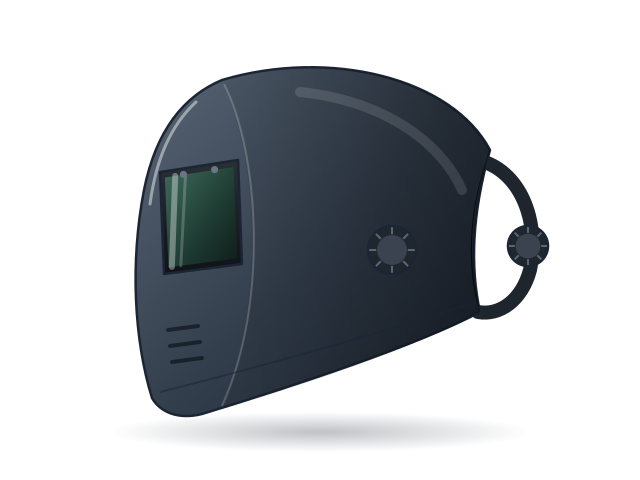
How to choose the best welding helmet: the checklist
- Documented protection. The maker's site or manual names ANSI Z87.1 (US) or CSA Z94.3 (Canada). Look for the Z87 mark on the shell and lens.
- Shade range. 9–13 covers MIG and stick; TIG under 50 A and plasma cutting want a 5–8 range too.
- Arc sensors. Four for out-of-position, pipe or under-vehicle work; two is fine at a bench.
- Optical class and window. 1/1/1/1 or 1/1/1/2 from the maker; 9 sq in or more if you weld for hours.
- Weight and headgear. Under about 600 g with ratchet headgear you can replace.
- Power and warranty. Solar plus a replaceable battery; 2+ years on the lens.
Welding shade explained
Shade numbers describe how dark the lens is. Every certified lens blocks UV and IR at every setting; shade is about seeing comfortably. OSHA sets minimums by process and current — start darker and go lighter until you can see the puddle:
| Process | Current / thickness | Minimum shade |
|---|---|---|
| Shielded metal arc (stick) | Under 60 A (electrode under 3/32 in) | 7 |
| Shielded metal arc (stick) | 60–160 A (3/32–5/32 in) | 8 |
| Shielded metal arc (stick) | 160–250 A (5/32–1/4 in) | 10 |
| Shielded metal arc (stick) | 250–550 A (over 1/4 in) | 11 |
| Gas metal arc (MIG) & flux-cored | Under 60 A | 7 |
| Gas metal arc (MIG) & flux-cored | 60–500 A | 10 |
| Gas tungsten arc (TIG) | Under 150 A | 8 |
| Gas tungsten arc (TIG) | 150–500 A | 10 |
| Air carbon arc cutting | Light, under 500 A | 10 |
| Air carbon arc cutting | Heavy, 500–1,000 A | 11 |
| Plasma arc welding | Under 20 A | 6 |
| Plasma arc welding | 20–100 A | 8 |
| Plasma arc welding | 100–400 A | 10 |
| Plasma arc welding | 400–800 A | 11 |
| Plasma arc cutting | Light, under 300 A | 8 |
| Plasma arc cutting | Medium, 300–400 A | 9 |
| Plasma arc cutting | Heavy, 400–800 A | 10 |
| Torch brazing | — | 3 |
| Torch soldering | — | 2 |
| Carbon arc welding | — | 14 |
| Gas welding | Light, plate under 1/8 in | 4 |
| Gas welding | Medium, 1/8–1/2 in | 5 |
| Gas welding | Heavy, over 1/2 in | 6 |
| Oxygen cutting | Light, under 1 in | 3 |
| Oxygen cutting | Medium, 1–6 in | 4 |
| Oxygen cutting | Heavy, over 6 in | 5 |
Source: OSHA 29 CFR 1910.133(a)(5), “Filter Lenses for Protection Against Radiant Energy”. These are minimums: OSHA advises starting with a shade too dark to see the weld zone, then going lighter until you see the zone clearly — never below the minimum. Shade 5 glasses and goggles are for gas welding, cutting and brazing only. See the OSHA standard.
Printable and embeddable version: welding lens shade chart.
Optical class: 1/1/1/1 vs 1/2/1/2
EN 379 rates a lens on four tests, each 1 (best) to 3: optical quality, light diffusion, shade evenness and angle dependence. A 1/1/1/1 lens is top in all four; 1/2/1/2 is a typical budget rating with more haze and more shade change at an angle. Lincoln and ESAB publish 1/1/1/1 for the Lincoln Electric Viking 3350 (Black) and ESAB Sentinel A60; Miller publishes 1/1/1/2 for its Digital range. Full detail: optical class explained.
Viewing area
Windows range from about 6 sq in on budget and entry helmets to 13.4 sq in on the Miller Digital Infinity ClearLight 4x (Black). Bigger helps out of position and for long sessions, but costs weight and money. Watch for listings that quote the cartridge size (often 4.5 × 5.25 in) instead of the visible window. See every verified window to scale on the comparison page.
Arc sensors and switching speed
Sensors detect the arc; four are much harder to block than two. Switching speed — typically 1/25,000 s — is how fast the lens darkens. Miller's X-Mode on the Miller Digital Elite ClearLight 4x (Black) adds electromagnetic sensing for when the sensors can't see the arc. How it all works: how auto-darkening helmets work.
True colour
True-colour lenses shift the view from green toward neutral so you can read the puddle. Lincoln (4C) and ESAB document theirs; on budget listings it's a marketing term with no standard behind it.
Weight and headgear
Verified weights run from 454 g (Miller Classic VS) to 644 g (ESAB Sentinel A60). Good headgear spreads the weight; replacement headgear is cheap — see headgear and how to adjust a welding helmet.
Types of welding helmets: helmet vs hood vs PAPR
- Auto-darkening helmet — the default; see the best auto-darkening helmets.
- Passive helmet — fixed shade, nothing to fail electronically; see passive helmets.
- Hood — pancake, sugar scoop, pipeliner or leather; see welding hoods.
- PAPR helmet — powered filtered air for fume-heavy work; see PAPR helmets, or wear one of our welding respirators under a standard helmet.
Types of welding shields
Hand-held shields (for observers), flip-front shields (passive helmets whose filter lifts to reveal a clear plate) and grind shields (clear visors built into some helmets). Only the first two filter arc light. For torch work, shade 5 welding goggles or welding glasses are enough; never use them for arc welding.
What to look for in a welding helmet
In short: documented ANSI Z87.1, a shade range for your process, four sensors if you weld out of position, a published optical class, and headgear you can replace. That's the welding helmet buying guide in one line. Short answers to the questions people ask most are in our welding helmet FAQ.
Welding helmet buying guide by budget
- Under $60: best budget welding helmet.
- $60–$150: best welding helmet for the money.
- $300+: the top of the best welding helmets ranking.
- Hood users: add a lens that fits — use the lens size finder.